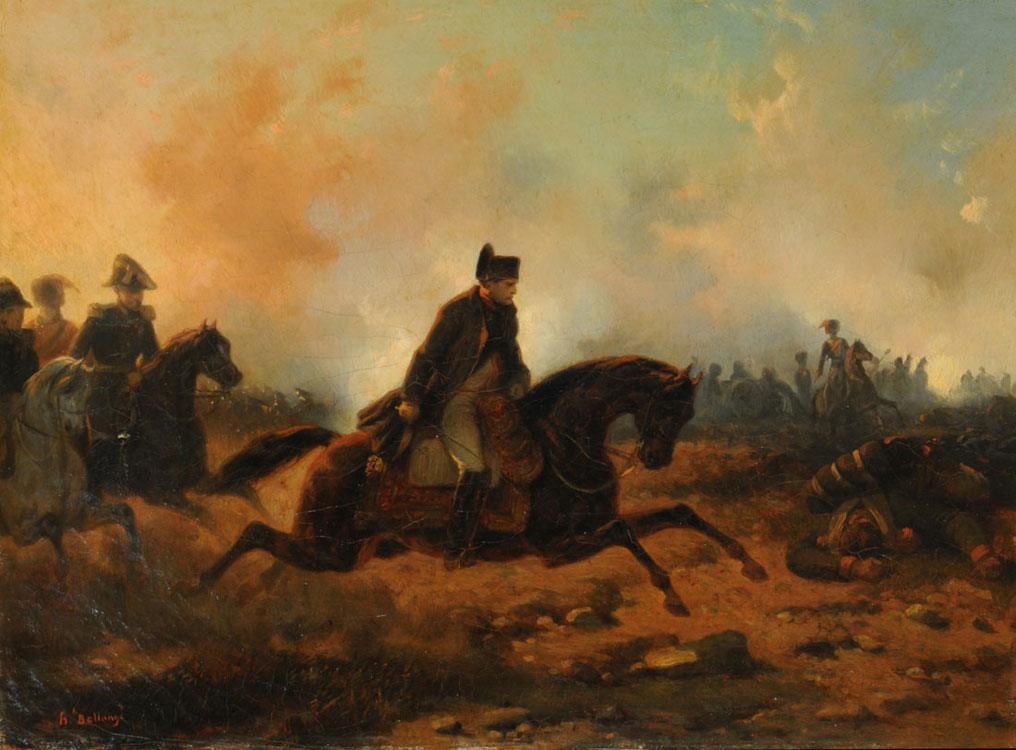
Drew Gray and Matthew McCormack from the University of Northampton offer contrasting reactions to Ridley Scott’s new film, Napoleon.
I must declare an interest here.
As a child I was obsessed with Napoleon. The ‘little corporal’ replaced Nelson as my boyhood hero and I devoured everything I could about him. At school I played wargames and still have about 500 miniature soldiers, each lovingly painted by the adolescent me. In 1970 I badgered my parents to take me to see Dino De Laurentiis’s ‘Waterloo’, with Rod Steiger playing the emperor and Christopher Plummer his nemesis, Wellington. I’ve seen it dozens of times since. I continued my interest in Napoleon into adulthood and he, and his world, was one of the reasons I returned to study history at university as a mature student.
So, I was looking forward to Scott’s ‘Napoleon’ way before it came out. Sadly, I don’t think I’ve ever been so disappointed in a film, to the extent that I am actually angry with Scott and almost everyone involved in this travesty of cinema.
The film is a little over 2.5 hours and that’s a long film but barely enough time to cover the life of one of history’s most divisive figures. Scott focuses on Napoleon’s tempestuous relationship with Josephine, whose back story is that of someone who survived The Terror by literally charming the pants off those she needed to. Napoleon’s personal life could have made for a fascinating film, but by sprinkling it with tableaux from his life (Toulon, ‘the whiff of grapeshot’, battle of the Pyramids, Moscow in flames, forced abdication in 1814) Scott tries to tell an epic story as well, and ends up doing neither one nor the other.
And let’s be clear, he gets so much wrong! From firing at the pyramids, to leading a charge at Waterloo, this film is peppered with inaccuracies. Then there is the acting. Joaquin Phoenix bears a passing resemblance to Napoleon but he looks the same in 1793 (clambering the walls of Toulon) aged 24 as he does careering towards the British squares in 1815, at 46. Throughout he in unconvincing and while Vanessa Kirby is much better as Josephine, even she descends into bathos in their divorce scene. That scene, along with the coup d’etat of 18th Brumaire are just ridiculous and the casting of inappropriate actors (e.g. Rupert Everett at Wellington, or Miles Jupp as Francis of Austria) do nothing to raise parts of this movie above the level of a poor French farce.
I quite liked Paul Rhys as Tallyrand but Sam Troughton was a wholly unconvincing Robespierre. And where was Marshall Ney? Where also were the chateau Hougemont and the farm of la Haye Saint at Waterloo? Waterloo, one of the most documented battles in history was an aberration. It looked more like the Western Front, with colour.
Overall, a bad film, badly cast, poorly scripted, dismissive of history, and devoid of characters one could relate to. A cartoon would have been better. But then we would have lost the cinematography and for this alone it is worth watching - Dariusz Wolski take a bow.
Drew Gray

I have been looking forward to this film for a while. In early 2022, I saw the set at Somerset House in London where they filmed the opening scene with the guillotine. And when the teaser trailer came out, my appetite was thoroughly whetted. I work on Britain in the long eighteenth century, and some of my research has been on the military during the Napoleonic Wars. I have mostly encountered Napoleon through British representations – often hostile or fearful, occasionally admiring, and frequently satirical.
So I was very interested to see what vision of Napoleon was portrayed in Ridley Scott’s new film, and I was not disappointed. Joaquin Pheonix is known for fully inhabiting his roles, and really getting under the skin of complex characters, and Bonaparte needed a treatment like this. Here he came across as amoral, proud, charismatic but disengaged, and a bit of a brat.
I think this is a legitimate take, and possibly not that far from reality. And it may explain why the film has alienated so many people, given how widely he is admired. It has gone down badly in France where the Napoleon cult is alive and well, and many historians (who should probably know better) are prone to admire him as a military genius or civil reformer.
Scott’s film is not a hagiography, and nor is it a conventional biopic or war film. It covers a huge period of history in two and a half hours flat – something that eluded Stanley Kubrick, who planned to tackle it over a series of films but never got the project off the ground (and made the brilliant Barry Lyndon instead).
For this reason, the narrative sometimes feels compressed and key things are missed out. Set pieces like Austerlitz, Borodino and Waterloo only get a few minutes each. If I had a criticism, it is that these huge battles seemed relatively small: in order to keep the storytelling tight, Scott only focused on a single element of battles where many things were happening at once. What we do see is visually impressive – the clash of French cavalry and British squares was well done – and he certainly does not hold back in conveying the bloody ferocity of combat.
As is often the way with military history, a great deal of heat has been generated over the question of authenticity. Scott has poured fuel on the fire by asking his critics, ‘excuse me, mate, were you there?’
For me, this rather misses the point. I don’t get too hung up on accuracy in historical drama: the most important thing is whether it captures the spirit of the period it is depicting, or whether it provides an interesting interpretation of it. And in this respect, I was very satisfied. Watching Scott’s film is like viewing a Gillray cartoon of Napoleon: quirky, grotesque, but giving us a window into the soul of a dangerous man.
Matthew McCormack
 HISTORY AT NORTHAMPTON